

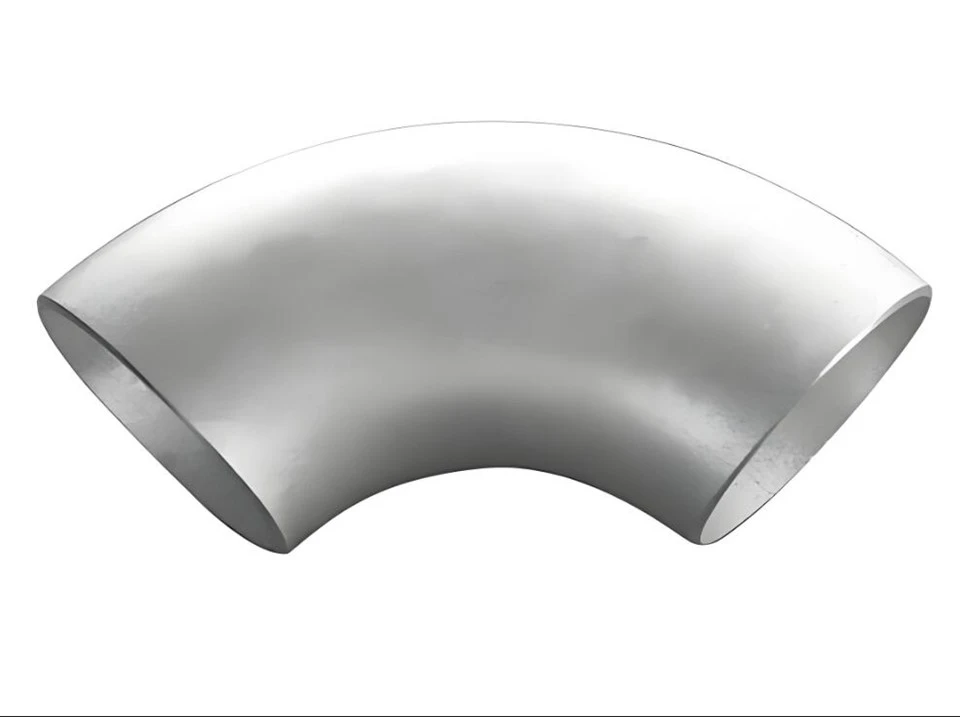
Description
Stainless Steel Forged Elbow is a stainless steel pipe fitting manufactured by forging process, which is used to achieve the angle change of flow direction in the pipeline system. The product is based on stainless steel material, and after heating and high-pressure forging, its internal structure is more compact and has higher mechanical strength. The forging process controls the deformation path and temperature distribution, so that the product has uniform metal flow lines and stable geometric dimensions, thus meeting the technical requirements for strength, pressure resistance and sealing of pipeline connection parts.
Features
Densification of forged structure
The stainless steel forged elbow is forged under high temperature and high pressure. The grains of the structure are arranged in a directional manner along the deformation direction to form a continuous streamline, eliminating defects such as pores and inclusions in the original cast material. Taking ASTM A182 F316L stainless steel as an example, its tensile strength can reach 485 MPa and its yield strength is 170 MPa in the heat treatment + forging state, which is about 10-20% higher than that of castings. The uniform grain refinement improves the resistance to crack propagation, making it have stronger structural stability and impact load bearing capacity in high-pressure fluid systems.
Corrosion resistance
Stainless Steel Forged Elbow mainly uses austenitic stainless steel materials such as 304, 316, and 316L. The chromium content is generally above 18% and the nickel content is 8%-12%. These elements can spontaneously form a passivation film on the surface of the material. The forging process compacts the internal structure of the material and reduces the inclusion rate to less than 0.5%. The pitting potential of 316L material in an environment with a chloride ion concentration of 1000 ppm is about 200 mV higher than that of 304, indicating that it has stronger pitting resistance. Therefore, this elbow is widely used in highly corrosive media environments such as chemical pipelines and seawater transportation.
High temperature resistance
Austenitic stainless steel can maintain good mechanical properties below 650°C. Forged elbows use high-temperature grade materials such as 316H, and their tensile strength remains above 415 MPa at up to 538°C. During the forging process, the material undergoes multiple thermal deformation treatments to form a stable austenite structure, avoiding the embrittlement problem caused by grain boundary precipitation phase. At the same time, its high-temperature yield strength is more than 10% higher than that of cast or rolled products, ensuring that premature creep or plastic deformation does not occur in high-temperature pipeline systems.
Excellent dimensional accuracy and sealing performance
The forging process can achieve near-net forming, with small machining allowances, and the dimensional error of the finished product can be controlled within ±0.5 mm. The wall thickness uniformity of the elbow joint is better than that of the casting, which effectively avoids stress concentration at the joint caused by wall thickness deviation. The surface roughness after processing can be controlled within Ra1.6-3.2 μm, which is conducive to the sealed connection with the pipeline system. Through metallographic structure inspection, the grain size of the forged elbow reaches above level 5, and the internal structure is uniform, which improves the connection reliability and anti-leakage ability, and is suitable for high-pressure sealing systems.
Hot Tags: stainless steel forged elbow, China stainless steel forged elbow manufacturers, suppliers, factory, stainless steel forging standards, Stainless Steel Forged Pipe Fittings, stainless steel forging applications, stainless steel forging suppliers, Stainless Steel Forged Fittings, stainless steel forging equipment


